 By
By 
“AGI” is everywhere in tech news in 2026, and in September OpenAI’s president said the industry had entered “the AGI era” while many researchers said it hadn’t. The arguments are confusing because people use the word to mean different things. Here’s what artificial general intelligence actually means, how it differs from the AI tools you use today, how researchers try to measure it, and what it changes (and doesn’t) for ordinary users.
Short answer: artificial general intelligence (AGI) means an AI system that can learn and do almost any thinking task a person can, across many different areas, rather than being good at one narrow job. OpenAI’s charter defines it as highly autonomous systems that outperform humans at most economically valuable work. There’s no agreed test for it, so whether AGI has “arrived” depends on whose definition you use, and experts still disagree.
Applies to: the AGI debate and AI tools as of October 2026. This is a fast-moving topic; we update this guide when major claims or benchmarks change.
What AGI means in plain English
Today’s AI tools are narrow in an important way: each is trained for particular kinds of tasks. A chatbot writes and answers questions, an image generator makes pictures, a chess engine plays chess. Some modern models can do many of these at once, which is why the line has become blurry.
AGI is the idea of a system with general ability: one that can pick up a new kind of task it was never specifically built for, reason through it, learn from mistakes, and do it about as well as a capable person, across most areas of work.
Example: a narrow AI can translate a contract. An AGI could, in principle, read the contract, notice a legal risk, research the law, draft a better clause, explain it to a client and handle the follow-up emails, all without being set up for each step.
Narrow AI vs AGI vs superintelligence
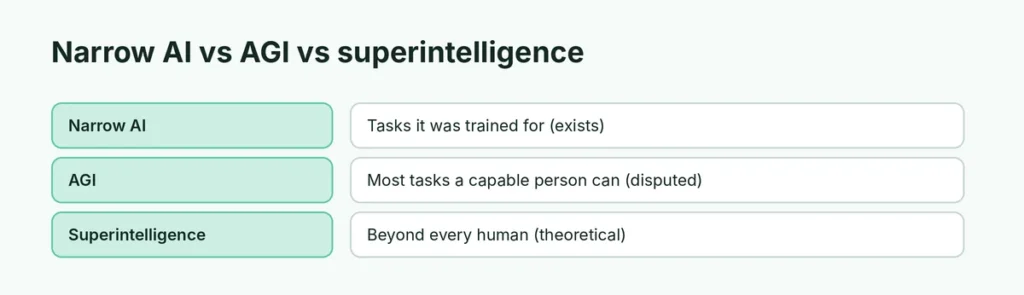
| Narrow AI | AGI | Superintelligence (ASI) | |
|---|---|---|---|
| What it can do | Specific tasks it was trained for | Most thinking tasks a capable person can | Far more than any human, in almost every area |
| Learns new kinds of tasks on its own | Limited | Yes | Yes |
| Exists today? | Yes (chatbots, image tools, voice assistants) | Disputed; no agreed test | No |
| Example | ChatGPT writing an email, Google Maps routing | Hypothetical “do any desk job” system | Purely theoretical |
The definitions people actually use
Part of the confusion is that the main players define AGI differently:
- OpenAI’s charter: “highly autonomous systems that outperform humans at most economically valuable work.” This is about jobs and economic value.
- Google DeepMind’s “Levels of AGI” (2023): a scale rather than a yes/no line, from Emerging to Competent, Expert, Virtuoso and Superhuman. In that paper, the researchers placed chatbots like ChatGPT at the Emerging level.
- Researchers and critics: many argue AGI should mean matching people at learning new things efficiently, not just scoring well on tests the system may have been trained toward.
Because the definitions differ, two experts can look at the same model and honestly disagree about whether it’s AGI.
Levels of AGI
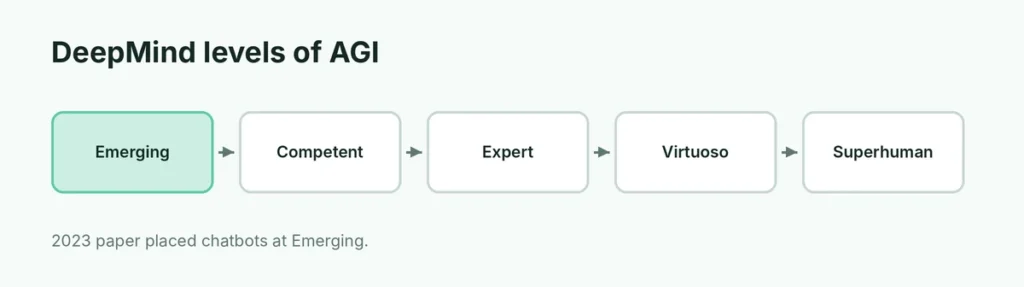
DeepMind’s framework is the easiest way to think about progress, because it measures both how well a system performs and how broadly:
| Level | Roughly means |
|---|---|
| Emerging | Equal to or somewhat better than an unskilled person |
| Competent | At least as good as a typical skilled adult (50th percentile) |
| Expert | Better than most skilled adults (90th percentile) |
| Virtuoso | Better than almost all skilled adults (99th percentile) |
| Superhuman | Better than every human |
A system can be “Expert” at a narrow task like coding and still be far below “Competent” at general reasoning, which is why a single headline score rarely settles the question.
How AGI is measured
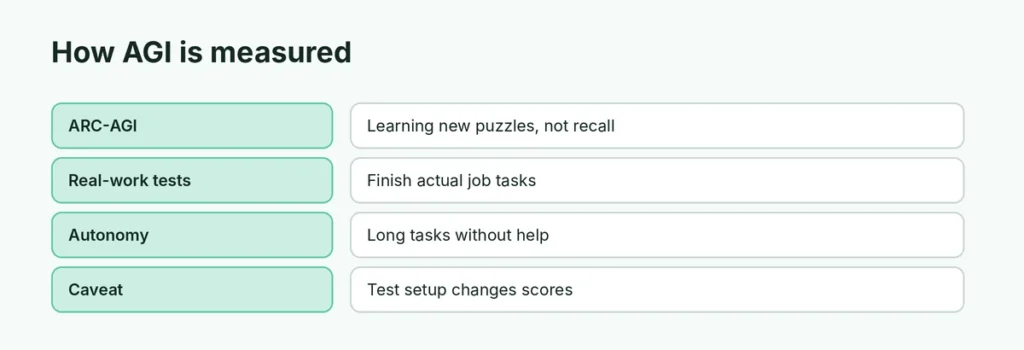
There’s no official AGI exam, but a few tests come up again and again:
- ARC-AGI (from the ARC Prize Foundation): puzzles that are easy for people but have historically been hard for AI, designed to test learning something new rather than recalling facts. The latest version, ARC-AGI-3, uses interactive game-like environments where an AI agent must explore, plan and adapt.
- Real-work tests: benchmarks that check whether AI can finish actual professional tasks, such as software engineering or office work, end to end.
- Autonomy: how long and how reliably a system can work on a multi-step task without a human stepping in.
High scores matter, but researchers warn that how a test is run (extra tools, memory, many attempts) can change results a lot.
Has AGI arrived? The 2026 debate
In September 2026, OpenAI released GPT-6 Astra, a model that can operate a computer, browser and spreadsheets on its own. OpenAI’s president Greg Brockman said he believes the industry has entered “the AGI era”, and OpenAI pointed to a very high score on ARC-AGI-3.
Others pushed back:
- Academics interviewed by Information Age argued that one benchmark can’t capture general intelligence and that “economically valuable work” is a value judgment, not a clean scientific test.
- The ARC Prize Foundation described the results as meaningful progress but did not say the model is AGI.
- OpenAI’s own CEO, Sam Altman, has called AGI a “very poorly defined” term.
The fair summary: today’s top models can do an impressive range of tasks, sometimes better than experts, but there’s no shared definition or test that everyone accepts, so “AGI has arrived” is a claim, not a settled fact.
What AGI would change for everyday users
Whether or not anyone declares AGI, the practical shift you’ll notice is AI that does tasks, not just answers questions:
- Agents that fill in forms, book appointments or organize files for you. See how ChatGPT agent mode works.
- AI built into the apps you already use, like Gmail, Word and your phone. Here’s what AI writing assistants in Gmail, Docs and Word can do today.
- Bigger questions about jobs, privacy and safety, which is why governments and AI companies publish safety rules for their most capable models.
How to use today’s AI tools safely
- Double-check facts. Even the most advanced models still make confident mistakes. Here’s how to use ChatGPT effectively and spot them.
- Be careful with agents. Review what an AI agent is about to do before it sends, buys or deletes anything.
- Protect your data. Don’t paste passwords or private documents, and learn how to stop AI chatbots training on your data.
- Compare tools, not hype. Our neutral Claude vs ChatGPT comparison shows what each is actually good at.
Related guides
- Who created ChatGPT?
- ChatGPT Free vs Plus
- How to turn off Gemini
The short version
AGI means AI that can learn and do almost any thinking task a capable person can, across many areas. OpenAI defines it as systems that outperform humans at most economically valuable work; DeepMind uses five levels from Emerging to Superhuman. In 2026, OpenAI says the “AGI era” has begun, but many researchers disagree because there’s no agreed test. For everyday users, the real change is AI that takes actions for you, so check its work and protect your data.
Sources
- OpenAI: OpenAI Charter
- MIT Technology Review: Google DeepMind wants to define what counts as artificial general intelligence
- ARC Prize: ARC-AGI technical guide
- TechRepublic: OpenAI launches GPT-6 Astra as Brockman says the AGI era has arrived
- Information Age (ACS): OpenAI says the AGI era is here. Experts disagree