 By
ChatGPT went from an unknown research preview to one of the most used apps in the world in just a few years. But who actually made it, when did it come out, and how has it changed since? Here’s a clear, plain-English history.
Short answer: ChatGPT was created by OpenAI, an artificial intelligence company based in San Francisco. It was released to the public on November 30, 2022, as a free “research preview” built on a model called GPT-3.5. OpenAI’s CEO is Sam Altman, and the company was founded in 2015 by a group including Sam Altman, Elon Musk, Greg Brockman, Ilya Sutskever and others.
Last updated: October 2026.
Who created ChatGPT?
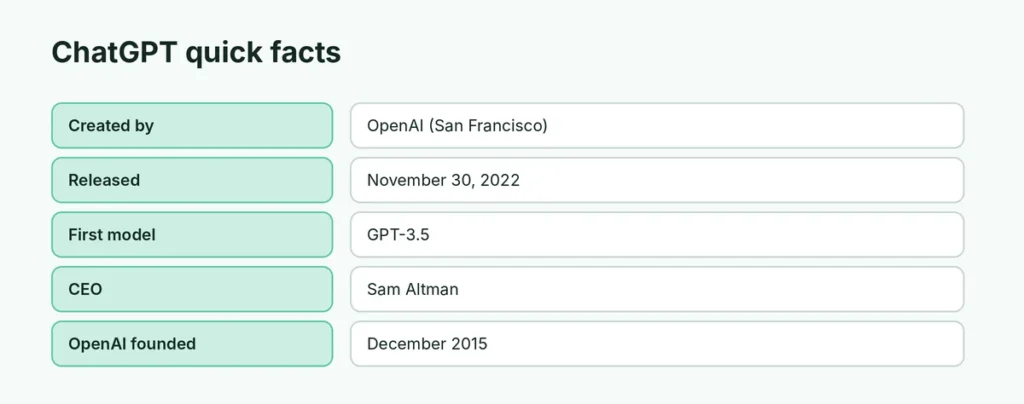
ChatGPT was built by OpenAI. Thousands of researchers and engineers have worked on the models behind it over the years, so there isn’t a single inventor. Key people often associated with it include:
- Sam Altman, OpenAI’s chief executive (CEO),
- Greg Brockman, co-founder and president,
- Ilya Sutskever, co-founder and former chief scientist (he left OpenAI in 2024),
- the research teams behind the GPT models and the training method that made ChatGPT good at conversation.
What is OpenAI?
OpenAI was founded in December 2015 as a non-profit AI research lab, with early backers including Sam Altman and Elon Musk (who left the board in 2018). In 2019 it created a “capped-profit” company to raise money, and Microsoft became its largest investor, providing billions of dollars and cloud computing. OpenAI has since restructured further, with the non-profit keeping control of the company.
When was ChatGPT released?
November 30, 2022. OpenAI launched it as a free research preview. It became the fastest-growing consumer app of its time: about 1 million users in 5 days and an estimated 100 million users within about two months.
What does “GPT” stand for?
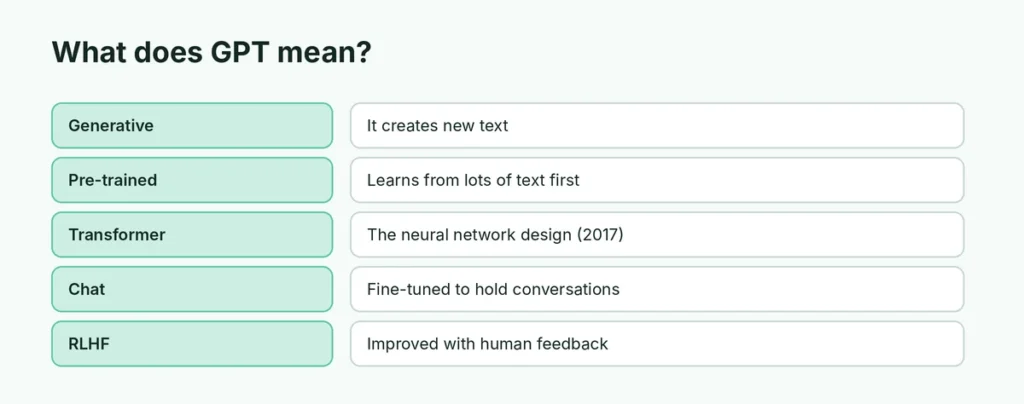
GPT means Generative Pre-trained Transformer:
- Generative: it creates new text.
- Pre-trained: it first learns from a huge amount of text before being fine-tuned.
- Transformer: the type of neural network design, introduced by Google researchers in 2017, that most modern AI language models use.
The “Chat” part was the key innovation: OpenAI trained the model to hold a conversation and follow instructions, partly using feedback from human reviewers (a technique called reinforcement learning from human feedback, or RLHF).
ChatGPT timeline
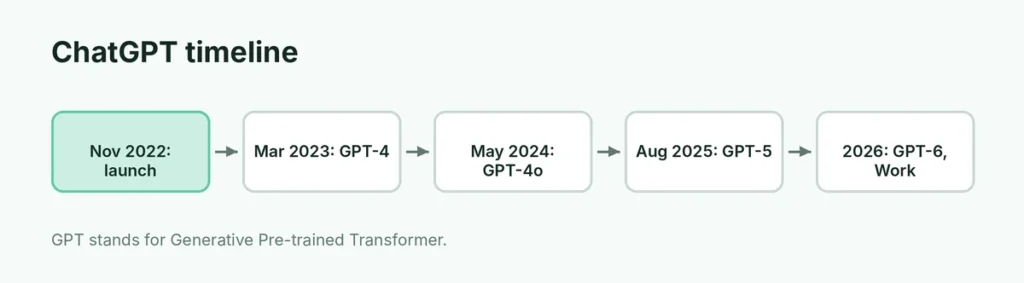
| Date | Milestone |
|---|---|
| Dec 2015 | OpenAI founded |
| 2018 | First GPT model |
| 2019 | GPT-2; Microsoft invests |
| 2020 | GPT-3 |
| Nov 30, 2022 | ChatGPT launches (GPT-3.5) |
| Feb 2023 | ChatGPT Plus subscription launches |
| Mar 2023 | GPT-4 released |
| May 2023 | ChatGPT iPhone app; Android app follows in July |
| Nov 2023 | Custom GPTs announced |
| May 2024 | GPT-4o: faster, with voice and vision |
| Late 2024 | Reasoning models (o1) and ChatGPT search |
| Aug 2025 | GPT-5 released |
| 2026 | GPT-6 models and the ChatGPT Work tab roll out |
Model names and features change often; ChatGPT now picks the best model automatically on the free plan.
Is ChatGPT free?
Yes, there’s a free plan with daily limits. Paid plans (Go, Plus and Pro) add higher limits and more advanced models. Here’s a detailed look at ChatGPT Free vs Plus, and how to cancel a ChatGPT subscription if you’ve signed up and changed your mind.
Who owns ChatGPT?
ChatGPT is owned and operated by OpenAI. Microsoft is a major investor and partner, and uses OpenAI’s models in products like Copilot, but it doesn’t own ChatGPT.
Was ChatGPT the first AI chatbot?
No. Chatbots go back to ELIZA in the 1960s, and assistants like Siri (2011), Alexa (2014) and Google Assistant (2016) came before ChatGPT. What made ChatGPT different was how naturally it could write, explain and answer almost anything in conversation, which made “generative AI” mainstream.
How did ChatGPT change things?
- Search and research: many people now ask AI assistants questions they used to type into search engines.
- Work: writing emails, summaries, code and reports with AI help became normal in offices.
- Education: schools and universities had to set new rules for AI use.
- Competition: Google (Gemini), Anthropic (Claude), Microsoft (Copilot), Meta and others launched their own assistants. Here’s a fair Claude vs ChatGPT comparison.
Who runs OpenAI today?
Sam Altman is CEO. In November 2023, OpenAI’s board briefly removed him, and he returned within days after most employees threatened to leave, a dramatic episode that led to a new board. Greg Brockman remains a co-founder and president. Several early leaders, including Ilya Sutskever and former CTO Mira Murati, have since left to start their own companies.
How does ChatGPT work, in simple terms?
ChatGPT predicts text. It was trained on a large amount of written material to learn patterns of language, then fine-tuned to follow instructions and have conversations. When you ask a question, it generates an answer one word-piece at a time, based on what’s most likely to be helpful. Newer models also “think” through problems step by step, search the web for current information, and work with images, voice and files.
How many people use ChatGPT?
OpenAI has reported hundreds of millions of weekly users, making it one of the most-used apps in the world. Usage keeps growing as it’s built into phones, browsers and work tools.
Fun facts about ChatGPT
- It was released as a “low-key research preview”; OpenAI didn’t expect it to become so popular.
- The name combines “Chat” with GPT, the model family behind it.
- Early on, it couldn’t browse the internet; its knowledge stopped at a fixed date.
- It supports dozens of languages, including Bengali, Spanish, Hindi and Arabic.
Concerns and debates
ChatGPT’s rise also brought debates about accuracy (it can state wrong things confidently), privacy (what happens to your chats), copyright (what it was trained on) and jobs. Using it well means checking important facts and protecting your data: here’s how to stop AI chatbots training on your data.
How to start using ChatGPT
Go to chatgpt.com or install the app, sign in, and type a question. Here’s a complete beginner’s guide on how to use ChatGPT.
The short version
ChatGPT was created by OpenAI, led by CEO Sam Altman, and released on November 30, 2022, based on GPT-3.5. OpenAI was founded in 2015 by Sam Altman, Elon Musk, Greg Brockman, Ilya Sutskever and others, and Microsoft is its biggest investor. Since launch, ChatGPT has moved through GPT-4, GPT-4o and GPT-5 to the GPT-6 models of 2026, and remains free to start.